


Why Dog Licenses Are Important: 7 Reasons That Matter
A dog license is a small yearly task with a surprisingly big payoff. Here is what it does for your dog, your wallet, and your whole community, plus exactly how to get one and how it fits with microchips and ID tags.

Picture this: the gate gets left open, your dog slips out, and a neighbor finds them three streets over. The very first thing that neighbor checks is the collar.
That little license tag, the one so many of us forget to renew, links your dog to a local record with your name and number on it. It is one of the quietest, hardest-working pieces of pet safety you can own.
Dog licenses can feel like paperwork. In this guide, we break down why dog licenses are important for pet parents and their communities, what one costs, how to get one, and how it works alongside a microchip and a personalized ID tag.
What Is a Dog License?
A dog license is an official registration issued by your city, county, or state that links your dog to you in a local database. You typically show proof of a current rabies vaccination, pay a small fee, and receive a numbered tag for your dog's collar. Most licenses renew every one to three years.
Depending on where you live, licenses come from a city or town clerk, a county treasurer, the local animal services department, or the health department. Some areas also let you license through your veterinarian or online.
The license record usually holds your dog's name, breed, age, sex, color, rabies vaccine details, and your contact information. The tag itself shows a license number, which shelter staff or animal control can look up.
Good to know: only your local licensing office can issue an official dog license. Personalized tags, including our Driver License Dog Tags, are ID tags that hang right next to the official one. They are a fun, helpful extra, not a replacement for your city or county license.
7 Reasons Dog Licenses Are Important
Here are the real benefits of licensing your dog, from protecting your pet to supporting every animal in your neighborhood.
1. It Is the Law in Most U.S. Communities
Most states and local governments require dogs to be licensed, usually starting somewhere between 3 and 6 months of age. Rules are set at the state, county, or city level, so the exact age, fee, and deadline depend on your address.
A few real examples show how this varies:
- Michigan: state law requires dogs over four months old to have a current rabies vaccination and a license tag (Saginaw County).
- Pennsylvania: dogs must be licensed by 3 months of age or when you bring them home, and skipping it can mean a fine of up to $500 plus court costs (License Your Dog PA).
- New Hampshire: dogs 4 months and older need a current license, with renewals due each spring.
Licensing also signals responsible pet parenting. It shows your community that your dog is vaccinated, registered, and cared for.
2. It Helps Bring a Lost Dog Home Faster
Every license tag carries a unique number tied to your record. If your dog is found, animal control officers and shelter staff can look up that number and contact you, even if your dog's ID tag has fallen off.
The research backs this up. In a national survey, the ASPCA found that 93% of lost dogs were recovered, and 15% of those dogs made it home because they wore an ID tag or had a microchip. Only 6% of dog parents found their pet at a shelter.
Some towns go a step further. One New York town's dog control officer notes they are happy to give any licensed dog a free ride home, which is a lot friendlier than an impound visit.
3. It Proves Your Dog's Rabies Vaccine Is Current
In almost every area, you cannot license a dog without proof of a current rabies vaccination. That makes the license tag a quick visual signal that your dog is protected.
This matters in real moments. A finder feels safer approaching a dog wearing a license tag, and if a bite ever happens, a current license can serve as fast proof of vaccination for local officials.
4. Licensed Dogs May Get More Time at the Shelter
When a dog arrives at a shelter without any identification, staff have no way to reach the family. Local officials in several areas note that licensed dogs tend to be held longer than unlicensed ones while staff work to contact the family.
A license record is also a clear proof of ownership. Without one, reclaiming your dog can take longer, cost more in impound fees, and involve extra paperwork.
5. It Costs Far Less Than the Fine
License fees are usually modest, especially for spayed or neutered dogs. Fines for an unlicensed dog are almost always higher.
| Location (example) | Typical license fee | Possible penalty |
|---|---|---|
| Halfmoon, NY | $10 spayed/neutered, $16 unaltered (per year) | $25 fine per dog, and the dog still must be licensed |
| Pennsylvania | $10.80 annual or $52.80 lifetime (as of the county flyer) | Up to $500 plus court costs |
| Pasadena, CA area | About $10 to $20 on average for a spayed/neutered dog | Up to $250 |
Fees change, so always check your local office for current pricing. Many areas also offer discounts for seniors, and some license service and working dogs at no charge.
6. Your Fee Funds Local Animal Services
License fees are not a cash grab. In many communities, that money goes right back into programs that help animals and people, such as:
- Running municipal shelters that house and care for lost and surrendered pets
- Sending animal control officers to rescue injured or loose animals
- Investigating animal cruelty and neglect (in Waukesha County, WI, license fees fund the Humane Officer Program)
- Bite-prevention and humane education programs in schools and neighborhoods
- Adoption programs that help shelter pets find new families
Licensing data also gives local governments a picture of how many dogs live in an area, which can shape how resources for dog-related programs are allocated.
7. It Protects Public Health in Your Community
Dog licensing is part of one of the biggest public health wins in U.S. history. According to the CDC, a combination of dog vaccination, licensing, and stray control helped eliminate the dog-to-dog strain of rabies in the United States by 2004.
The numbers are striking. The CDC's rabies compendium reports that laboratory-confirmed rabies cases in dogs fell from 6,949 in 1947 to 94 in 2004. Today, dogs make up only about 1% of reported animal rabies cases.
Rabies still lives in wildlife like bats, raccoons, skunks, and foxes. Every licensed, vaccinated dog helps keep that protective wall standing for pets and people alike.
How to Get a Dog License, Step by Step
Getting a dog license is usually quick. Here is the process most U.S. communities follow:
- Find your licensing office. Search "[your city or county] dog license" to find the right agency. It is often the city clerk, county treasurer, or animal services.
- Gather your documents. You will typically need a current rabies certificate, a spay/neuter certificate for the reduced fee, and your dog's name, breed, age, sex, and color.
- Apply and pay. Many areas let you apply online, by mail, or in person. Some vets can process it for you during a visit.
- Attach the tag. Clip the official license tag to your dog's collar, where many local rules require it to be displayed.
- Set a renewal reminder. Pair it with your dog's rabies booster date so both stay current together.
How Much Does a Dog License Cost?
Most annual licenses cost roughly $6 to $25. Spayed or neutered dogs usually pay less than unaltered dogs, and some areas offer multi-year or lifetime licenses that save time and money.
How Long Does a Dog License Last?
Most licenses are valid for one year. Some jurisdictions offer two- or three-year licenses that match a three-year rabies vaccine, while others require yearly renewal no matter how long the vaccine lasts.
Moving to a New City or State?
Licenses usually do not transfer between jurisdictions. Plan to license your dog again in your new area, then update your microchip registry and your dog's ID tag with your new address and phone number.
What Happens If You Do Not License Your Dog?
Skipping a license rarely ends well. Depending on your location, you could face:
- A citation, a fine, or a court appearance ticket
- Monthly late fees that stack up until you renew
- Higher impound fees if your dog is picked up
- A harder time proving ownership at a shelter
- Slower identification if your dog gets lost without other ID
In many places, paying the fine does not cancel the requirement. You still have to license your dog afterward.
Common Dog License Myths
"My dog never goes outside, so I do not need one."
Licensing laws generally apply to indoor dogs too. And indoor dogs are often the ones that panic and bolt when a door is left open, since everything outside feels unfamiliar.
"My dog is microchipped, so we are covered."
A microchip is wonderful, but it is not a license. It also needs a scanner to read, so a neighbor who finds your dog cannot see your information on the spot.
"The rabies tag from my vet is the same thing."
Not quite. A rabies tag links to your vet's vaccination record, while a license tag links to your local government's licensing record. Many dogs wear both.
"License fees are just a money grab."
Those fees typically fund shelters, animal control, cruelty investigations, and education programs that benefit every pet in your area.
Dog License vs Microchip vs ID Tag: What Each One Does
Each form of identification has a different job. Used together, they give your dog the most ways to get back to you.
| Feature | Official license tag | Microchip | Personalized ID tag | QR code ID tag |
|---|---|---|---|---|
| Who provides it | City, county, or state | Veterinarian or shelter | You choose it | You choose it |
| Legally required | Yes, in most areas | Rarely | Sometimes, varies by area | No |
| What a finder sees | A license number | Nothing without a scanner | Your pet's name and your phone | A scan-to-contact profile |
| Special equipment needed | Office lookup | Microchip scanner | None | Any smartphone camera |
| Proves rabies vaccine | Yes | No | No | No |
| Easy to update when you move | Re-license locally | Update the registry | Order a new tag | Update the profile |
| Best for | Legal compliance and shelter lookup | Permanent backup ID | Fast calls from neighbors | Sharing more details quickly |
Here is the catch: many pets do not wear any tag at all. An ASPCA study found that while 80% of pet parents believe ID tags are very or extremely important, only 33% said their pets always wore one.
Pairing Your License With a Personalized ID Tag
A license tag shows a number, not your phone. If your dog is found on a Saturday night, the finder may have to wait until the licensing office opens to reach you.
That is where a personalized ID tag shines. It puts your pet's name and your phone number right where a kind neighbor can see it, so you can get the call within minutes. Here are three ways to build your dog's ID setup.
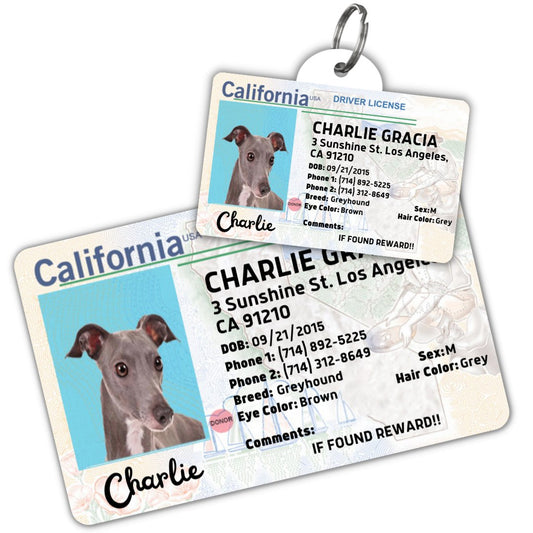
Driver License Dog Tags
All 50 states plus DC • Lightweight aluminum • 1.75 x 1.1 in
Styled like a real state driver's license with your pet's photo, name, and details, plus your address and contact info on the back. Choose tag only or tag and a PVC wallet card. A playful, personal ID tag to wear alongside the official license.
Shop License TagsQR Code Dog Tags
Solid stainless steel • 3-tone engraving • 30 mm circle
The back always carries a laser-etched QR code. A finder scans it with any smartphone camera, no app needed, to reach your pet's contact profile. It shares your contact details when scanned; it does not track location.
Shop QR Code TagsEngraved Dog Tags
Solid stainless steel • 4 shapes • 4 finishes
Deep laser engraving made to stay legible for years. Add your pet's name on the front, then up to 80 characters or a QR code on the back.
Shop Engraved TagsWhat to Put on Your Dog's ID Tag
- Your pet's name
- Your cell phone number (the most important line)
- A backup number, like a partner or trusted friend
- Your city or address, only if you are comfortable sharing it
- A short note such as "Microchipped" or "Needs meds," if space allows
How to Wear Both Tags Comfortably
Every PawFurEver tag includes a 20 mm stainless steel split ring, so you can hang it on your dog's collar D-ring right next to the license and rabies tags. A sturdy collar keeps the whole set secure, and our waterproof biothane dog collars wipe clean after muddy walks.
Your Dog License Checklist
- ☐ Look up your city or county licensing rules and deadline
- ☐ Confirm your dog's rabies vaccine is current
- ☐ Find your spay/neuter certificate for the reduced fee
- ☐ Apply and pay online, by mail, or in person
- ☐ Attach the license tag to your dog's collar
- ☐ Add a personalized ID tag with your phone number
- ☐ Check that your microchip registry has your current info
- ☐ Set a calendar reminder for renewal
Frequently Asked Questions
Do I really need a dog license?
In most U.S. cities, counties, and states, yes. Licensing is a legal requirement that usually starts when a puppy is 3 to 6 months old. Check your local animal services or clerk's office for your exact rules.
How much does a dog license cost?
Most annual licenses cost about $6 to $25. Spayed or neutered dogs usually pay less, and some areas offer senior discounts, multi-year licenses, or lifetime licenses.
Do indoor dogs need a license?
Yes, licensing laws generally apply to indoor and outdoor dogs alike. Indoor dogs can still slip out through an open door or gate.
Is a microchip the same as a dog license?
No. A microchip is a permanent ID read with a scanner, while a license is a legal registration that also proves rabies vaccination. Most areas require the license even if your dog is microchipped.
How long is a dog license good for?
Usually one year. Some areas offer two- or three-year licenses tied to the rabies vaccine, and a few, like Pennsylvania, offer lifetime licenses.
Can I get a dog license online?
Many cities and counties now offer online licensing. You upload your rabies certificate, pay the fee, and the tag arrives by mail.
What if my dog's license tag gets lost?
Contact your licensing office for a replacement. Most offices can reissue a tag for a small fee, since your record is already on file.
At what age does a puppy need a license?
It depends on your location, but most areas require a license between 3 and 6 months of age, often once the puppy receives its first rabies vaccine.
Does a PawFurEver Driver License Dog Tag count as an official license?
No. Our Driver License Dog Tags are personalized ID tags styled like a state license. Your official dog license must come from your city, county, or state, and the two work beautifully together on one collar.
Quick answer: Dog licenses are important because they are legally required in most U.S. communities, link your dog to you in a local database, prove a current rabies vaccine, can give your dog more time at a shelter, cost less than the fines, and fund local shelters and animal services. Pair the license with a microchip and a personalized ID tag for layered protection.
The Bottom Line
A dog license is one of the simplest ways to protect your pet, respect your local laws, and support the animals in your community. It takes a few minutes a year, and the fee is usually small.
Once your official license is on the collar, give your dog one more layer of peace of mind with a personalized ID tag made just for them.
Licensed and looking sharp? Add a personalized ID tag so a kind neighbor can reach you fast. Personalized and shipped from Maryland in 2 business days.
Shop Driver License Dog Tags
RELATED POSTS


