


Small Dog Collars: How to Choose the Right Fit

Little necks need a different kind of collar. Here is how to pick small dog collars that fit right, feel light, and keep ID where it belongs, from the very first puppy collar to the one they grow into.
Your new puppy weighs about as much as a bag of flour, and the collar aisle is full of gear built for Labradors. Heavy buckles, wide straps, and size charts that start right where your pup's neck ends. Sound familiar?
Choosing small dog collars is less about looks than most pet parents expect. It comes down to a light, correct fit, a closure you can trust, and a dependable place to hang ID. Get those right and the fun part, picking colors and personalization, gets easy.
Our team cuts, punches, and assembles waterproof collars in our Maryland shop, so we see a lot of little necks and a lot of sizing questions. This guide covers everything we walk new pet parents through: measuring, width, collar types, materials, growing puppies, and when a harness should take over the walking.
Quick answer: To choose a collar for a small dog or puppy, measure the neck snugly, then make sure two fingers fit underneath. Pick a narrow strap (about 3/8 to 5/8 inch for toy breeds, 3/4 inch for larger small breeds), a secure buckle, and a sturdy D-ring for an ID tag. Use a harness for walks if your breed is prone to tracheal collapse.
Why small dogs need a different collar
A collar that disappears on a 70-pound dog can feel like a necklace made of chain on a 5-pound one. Small dogs need gear proportioned to them, for three practical reasons.
Delicate necks and airways
Toy and small breeds have small, more fragile windpipes. The American Kennel Club explains that in some breeds and older dogs, the cartilage rings of the trachea can weaken and flatten. Repeated leash pressure on the throat is one reason vets often steer these dogs toward harnesses for walks.
Weight adds up fast
A wide strap, oversized buckle, and three dangling tags can be a real share of a tiny dog's body weight. Lighter, narrower gear is simply more comfortable for all-day wear.
Small heads slip out easily
Many small breeds have narrow heads, and puppies are experts at wriggling. A collar that is even slightly loose can slide right over the ears during a startle, which is exactly when you need it to stay put.
ID is still the main job
In a national ASPCA survey, 93% of lost dogs were recovered, and 15% of those dogs came home because they wore an ID tag or had a microchip. Yet in a separate ASPCA ID study, 80% of pet parents called ID tags very important while only 33% said their pet wore one all the time. A comfortable collar is what makes full-time ID realistic.
The 4-S Collar Check: a simple framework
Before you fall for a color, run any collar through these four checks. If it passes all four, style is the easy part.
- Size: Does it fit your dog's measured neck with two fingers of room, with your measurement near the middle of the adjustment range?
- Structure: Is the strap narrow and light enough for your dog's weight, with hardware that is riveted or securely stitched, not glued?
- Security: Will the buckle stay closed under a sudden pull, and is the D-ring strong enough to hold a leash and a tag?
- Signal: Does it carry readable ID, and does it help your dog be seen on evening walks?
How to measure a small dog or puppy for a collar
Guessing by breed is the most common sizing mistake we see. A two-minute measurement saves a return and a lot of frustration.
- Grab a soft measuring tape. No tape? Use a piece of string or a phone charging cable, then lay it against a ruler.
- Find the collar spot. Measure around the middle of the neck, where a collar naturally rests, not down by the shoulders.
- Measure snug against the skin. Part the fur so the tape touches skin. Measuring over a fluffy coat makes the number too big.
- Do the two-finger test. Once the collar is on, two fingers laid flat should slide underneath without forcing.
- Do the head test. Gently pull the collar forward toward the ears. It should not slip over the head.
- Choose the size, not the edge. Pick a size where your number lands near the middle of the range. For puppies, landing toward the lower end leaves room to grow.
How wide should a small dog collar be?
Width is a comfort and proportion choice. As a general guide:
- Under about 10 lb (Chihuahuas, Yorkies, Maltese, toy puppies): roughly 3/8 to 5/8 inch.
- About 10 to 25 lb (Shih Tzus, Boston Terriers, Pugs, mini Dachshunds): roughly 5/8 to 3/4 inch.
Very narrow straps on a strong puller concentrate pressure, while straps that are too wide can rub and feel bulky on a short neck.
Small dog collar size chart by breed
Use this as a starting point, never a substitute for a tape measure. Individual dogs vary a lot, especially fluffy or mixed breeds.
| Breed (adult) | Typical neck size | Typical weight | PawFurEver size to start with |
|---|---|---|---|
| Chihuahua | 7 to 10 in | Under 6 lb | Small (7 to 10.5 in) |
| Yorkshire Terrier | 8 to 11 in | About 7 lb | Small |
| Maltese | 8 to 12 in | Under 7 lb | Small |
| Pomeranian | 8 to 12 in | 3 to 7 lb | Small |
| Toy Poodle | 8 to 12 in | 4 to 6 lb | Small |
| Shih Tzu | 10 to 14 in | 9 to 16 lb | Small or Medium (measure) |
| Miniature Dachshund | 10 to 14 in | 11 lb and under | Small or Medium (measure) |
| Miniature Schnauzer | 11 to 15 in | 11 to 20 lb | Medium (10.5 to 15 in) |
| Cavalier King Charles Spaniel | 12 to 16 in | 13 to 18 lb | Medium |
| Boston Terrier | 12 to 15 in | 12 to 25 lb | Medium |
| Pug | 13 to 16 in | 14 to 18 lb | Medium or Large (measure) |
| French Bulldog | 14 to 18 in | Under 28 lb | Medium or Large (measure) |
Neck ranges are approximate adult sizes. Our Small collar fits necks from 7 to 10.5 inches, so if your puppy measures under 7 inches today, start with a lighter adjustable puppy collar and move to biothane once they grow into it.
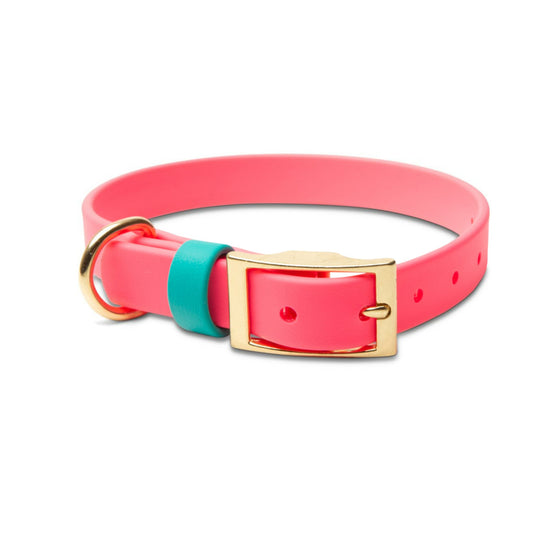
Waterproof Biothane Dog Collar
Small: 7 to 10.5 in neck, 5/8 in wide · Medium: 10.5 to 15 in, 3/4 in wide
Coated biothane that does not absorb water or trap odor, with solid brass and nickel-plated hardware. Cut and assembled by our team in Maryland. Wipes clean after muddy walks and puppy slobber.
Shop Waterproof CollarsSmall dog collar types compared
Not every collar style suits a small dog. Here is how the common options stack up for little necks and growing puppies.
| Type | How it works | Good fit for | Watch out for | Puppy friendly? |
|---|---|---|---|---|
| Flat buckle collar | Fixed size, fastened with a pin or metal buckle | Everyday ID, calm walkers | Can slip off narrow heads if loose | Yes |
| Quick-release (side-release) | Plastic clip snaps open and shut | Fast on and off, adjustable sizing | Clips can wear or pop open under a hard pull | Yes, with fit checks |
| Martingale (limited slip) | Tightens a set amount when pulled | Escape artists, narrow-headed breeds | Should not be left on unsupervised | Older puppies, supervised |
| Breakaway collar | Releases under strong pressure | Crate time, multi-dog play | Not for leash walking | Yes, for home use |
| Harness (not a collar) | Spreads leash pressure across chest and shoulders | Walks for toy breeds, pullers, flat-faced dogs | Needs its own careful fit | Yes |
| Choke, prong, or shock collar | Uses pressure or discomfort to correct | Not recommended for small dogs | Concentrated force on a fragile neck | No |
Flat buckle collars
The everyday workhorse. A flat collar with a secure buckle holds an ID tag, takes a leash for short calm walks, and stays on without fuss. For most small dogs, this is the collar that lives on their neck.
Quick-release collars
Convenient for wiggly puppies, and the clip makes on and off fast. The trade-off: plastic clips can loosen or crack over time, so check them as often as you check fit.
Martingale collars
If your dog is a known backer-outer, a martingale closes just enough to stop the slip without choking. It is a walking tool, so take it off at home.
Breakaway collars
Designed to release if snagged, which makes them a smart option for crate time and rough play between dogs. Because they release under pressure, they are not meant for leash walks.
Collar materials for small dogs: what actually matters
Material affects weight, comfort, cleaning, and how long a collar looks good. Here is an honest look at the main choices.
| Material | Strengths | Trade-offs | Good match |
|---|---|---|---|
| Nylon webbing | Very light, lots of colors, easy to adjust | Absorbs water and odor, edges can fray | Tiny puppies, first collars |
| Leather | Classic look, softens with age | Needs conditioning, dislikes water | Dry-climate, indoor-leaning dogs |
| Biothane (coated webbing) | Waterproof, does not trap odor, wipes clean, flexible in cold | Does not float; solid hardware adds some heft | Active, messy, or water-loving small dogs |
| Padded or neoprene | Cushioned feel | Bulkier, holds moisture | Dogs with sensitive skin |
| Fabric, velvet, or ribbon | Soft and decorative | Stains easily, less durable | Special occasions and photos |
Why we build our collars from biothane
Small dogs live close to the ground. Puddles, dew-soaked grass, drool, and the occasional roll in something smelly all land on the collar. Biothane is polyester webbing coated on both sides, originally developed for horse harnesses, so it does not soak up water or hold odor. A damp cloth handles most cleanups.
The color is part of the coating rather than printed on top, so it will not peel and holds up to wet walks. One honest note: waterproof is not the same as buoyant. Biothane collars do not float, so if your little swimmer goes boating, a dog life jacket is still the move.
Hardware: the part most people forget
- Buckle: Metal buckles hold up better over time than thin plastic clips, especially for dogs who pull.
- D-ring: Look for a solid ring sized to the strap. It carries both the leash and the ID tag.
- Attachment: Rivets or tight stitching should hold the hardware in place. Avoid glued components.
- Corrosion: Our collars use solid brass and nickel-plated hardware. Wipe it dry after swims to keep it bright; brass naturally develops a patina over time.
Choosing a collar for puppies: what changes while they grow
A collar for puppies has one main job in the early months: hold ID comfortably without getting in the way of play, sleep, and learning. The perfect forever collar can wait a little.
When to start
Most puppies can start wearing a light collar as soon as they come home, often around 8 weeks old. Keep the first sessions short and happy: collar on, treat, play, collar off. Most pups forget about it within a few days.
Plan for growth
Puppies can outgrow a collar in weeks. Check fit every week, and size up when two fingers no longer slide under the collar on its loosest setting. A too-tight puppy collar can rub skin raw before you notice it under the fur.
A simple puppy collar timeline
- 8 to 12 weeks: Introduce a light, adjustable collar with an ID tag. Short supervised wear sessions.
- 3 to 6 months: Fastest growth. Weekly fit checks, likely one size change.
- 6 to 12 months: Many small breeds approach adult size. Time to choose a durable everyday collar.
Teething, crates, and littermates
Puppies chew their own gear and each other's. Choose materials that wipe clean, and take the collar off or switch to a breakaway style in the crate, since tags and collars can catch on crate wire. Put it back on before any outing so ID always leaves the house with your pup.
Collar vs harness for small dogs: let each do its job
This is where small dog advice gets loud, and often oversimplified. Here is the balanced version.
Tracheal collapse is far more common in toy and small breeds, including Yorkshire Terriers, Pomeranians, Toy Poodles, and Chihuahuas. Genetics play a big role, but pressure on the windpipe from pulling against a collar can make symptoms worse. Flat-faced breeds like Pugs and French Bulldogs also benefit from keeping pressure off the throat.
That does not make collars the enemy. A well-fitted, lightweight collar is still the simplest way to keep visible ID on your dog every day. The setup we see work for many small-dog families:
- Collar: worn daily, carries the ID tag, light and correctly sized.
- Harness: clipped to the leash for walks, especially for pullers, toy breeds, and seniors.
- Vet check: if you hear a dry, honking cough, especially when your dog is excited or pulling, schedule a visit and walk on a harness only until you get answers.
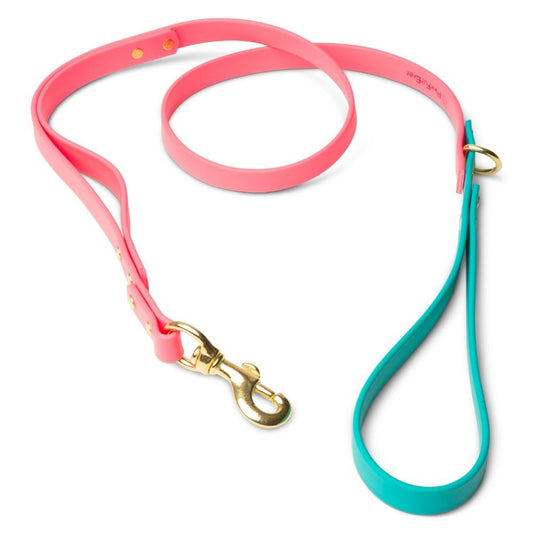
Waterproof Biothane Dog Leash
4.5 ft or 6 ft · 3/4 in wide · traffic handle on every leash
Every collar colorway has a matching leash from the same biothane run. The second grip above the snap hook gives close control at crossings without wrapping the leash around your hand.
Shop Matching LeashesID tags for small dogs: light, legible, and always on
A collar without ID is just an accessory. For small dogs, the tag needs to be readable without being heavy or noisy.
Pick a tag sized to your dog
Our smallest engraved shape is the 30 mm Circle (about 1.18 inches), a comfortable size for toy breeds. Our QR Code Dog Tags use the same 30 mm Circle and are light enough for puppies and small breeds while still sitting comfortably on bigger dogs.
What to put on it
- Your dog's name.
- One or two phone numbers you actually answer.
- A short note if space allows, such as "Microchipped" or "Needs meds."
Engraved, Breed, and Birth Flower tags offer up to 80 engraved characters on the back, or a laser-etched QR code instead.
QR tags and microchips work together
A QR code links to your pet's contact profile, so anyone with a smartphone camera can scan it, no app needed, and reach you quickly. It is a scan-to-contact tool, not GPS tracking. Pair it with a registered microchip: one study summarized by dvm360 found microchipped dogs in shelters were returned to their families 52.2% of the time, compared with 21.9% of dogs without chips.
Keep the jingle down
Three or four dangling tags can be heavy and loud on a 6-pound dog. Consolidate rabies and license info where your local rules allow, and keep one personalized tag as the main ID.
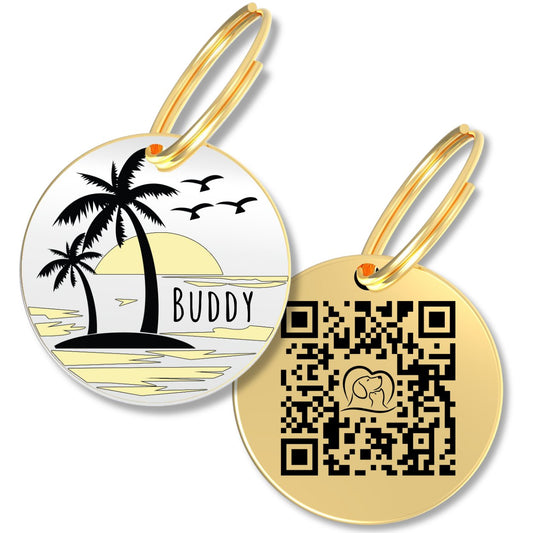
QR Code Dog Tags
Stainless steel · 30 mm Circle · QR back on every tag
3-tone laser engraving on the front, a laser-etched QR code on the back that links to your pet’s contact profile. Light enough for puppies and small breeds.
Shop QR Code Tags
Breed-Specific Dog Tags
Stainless steel · 4 shapes · Silver, Gold, or Rose
A peek-a-boo engraving of your dog’s breed with their name in script, plus up to 80 characters or a QR code on the back. 99 breeds, from Shih Tzu to Golden Retriever.
Find Your BreedStyle and personalization without trading off safety
Once the 4-S Check is covered, have fun with it. A few ideas small-dog families love:
- Match the set: collar and leash colorways come from the same biothane run, so the colors match.
- Think visibility: our Blue Reflective and Pink Reflective waterproof collars have reflective threading built into the biothane surface for dusk and early-morning walks.
- Personalize the tag, not the collar: our collars are not printed with names, so the tag is where your dog's name and your contact info live.
- Celebrate milestones: a Birth Flower tag for a birthday or gotcha day, or a seasonal holiday tag.

Engraved Dog Tags
Stainless steel · 4 shapes · Silver, Gold, Rose Gold, or Black
Deep laser engraving made to stay legible for years. Add your pet’s name to the front and up to 80 characters or a QR code on the back. The 30 mm Circle suits small necks.
Shop Engraved TagsReal-world examples: three small dogs, three setups
These are illustrative scenarios based on the questions we hear most often from pet parents.
Example 1: A 4-month-old Shih Tzu puppy
Her neck measures 9 inches. A Small collar (7 to 10.5 in) puts her near the middle of the range with room to grow. She wears a QR Code tag, walks on a harness while she learns leash manners, and gets a fit check every Sunday. Her family expects to move to a Medium as she fills out.
Example 2: A 14-pound beach-loving Dachshund mix
His neck measures 12 inches, so a Medium 3/4-inch waterproof collar fits well. Salt water, sand, and wet fur were wrecking his old fabric collar; biothane wipes clean and does not hold the smell. Since the collar does not float, he wears a life jacket on the paddleboard.
Example 3: A 10-year-old Pomeranian with a new cough
His family noticed a honking cough on walks. After a vet visit, all leash walks moved to a harness. He still wears a lightweight collar at home as his ID carrier, with "Needs meds" and two phone numbers engraved on the back of his tag.
Small dog collar safety checklist
Your weekly 60-second check
- Two fingers still slide under the collar.
- The collar will not slip over the ears when pulled forward.
- No redness, hair loss, or rubbing under the strap.
- Buckle closes firmly; D-ring and rivets are tight.
- Tag engraving is readable and the split ring is closed.
Replace the collar right away if
- The strap is cracked, torn, or frayed.
- The buckle opens on its own or the clip feels loose.
- Your dog has outgrown the loosest setting.
Frequently asked questions
What type of collar is good for a small dog?
For everyday wear, a lightweight flat collar with a secure buckle and a sturdy D-ring for the ID tag works well for most small dogs. Choose a narrow strap (about 3/8 to 5/8 inch for toy breeds, 5/8 to 3/4 inch for larger small breeds). Dogs that back out of collars may do better in a martingale, and breeds prone to tracheal collapse should walk on a harness.
What size collar does a small dog need?
Measure around the middle of the neck, snug against the skin, then choose a size where that number falls near the middle of the range so you can still fit two fingers underneath. Most toy breeds measure roughly 7 to 12 inches, and larger small breeds like Pugs or Boston Terriers often measure 12 to 16 inches.
How tight should a puppy collar be?
You should be able to slide two fingers flat between the collar and your puppy's neck. Any tighter can rub or restrict breathing; any looser and a puppy can back out of it or snag a paw. Also check that the collar will not slip over the ears when gently pulled forward.
When can a puppy start wearing a collar?
Most puppies can start wearing a light collar as soon as they come home, often around 8 weeks old. Start with short, supervised sessions paired with treats and play, and lengthen the time as your puppy stops scratching at it.
How often should I check my puppy's collar fit?
Check it once a week during the fast-growth months, and any time your puppy has a growth spurt. If two fingers no longer slide under the collar on its loosest setting, it is time to size up.
Should a small dog wear a collar or a harness?
Many small-dog families use both. The collar carries ID full time, and a harness takes the leash pressure on walks. A harness is strongly recommended for breeds prone to tracheal collapse, such as Yorkshire Terriers, Pomeranians, Toy Poodles, and Chihuahuas, and for flat-faced breeds.
Can a collar cause a collapsed trachea in small dogs?
Tracheal collapse is largely linked to genetics and weakening tracheal cartilage, but repeated pulling against a collar puts pressure on the windpipe and can make symptoms worse. If your dog has a honking cough, see your veterinarian and switch leash walks to a harness.
Should my puppy wear a collar in the crate or overnight?
Many trainers suggest removing the collar, or using a breakaway collar, when a puppy is crated or unsupervised, because a collar or tag can catch on crate wire. Put it back on before outings so ID is always on when your puppy leaves the house.
Are biothane collars good for small dogs and puppies?
Biothane is a coated webbing that does not absorb water, does not trap odor, and wipes clean, which makes it practical for puppies who drool, chew, splash, and roll. It stays flexible in cold weather. Keep in mind it does not float, and solid metal hardware adds some heft, so very tiny pups under about 5 pounds may start in a lighter collar first.
What should I put on my small dog's ID tag?
Keep it short and readable: your dog's name and at least one phone number, ideally two. If space allows, add a short note such as "Microchipped" or "Needs meds." A QR code back can hold more detail in a scan-to-contact profile that helps a finder reach you.
Key takeaways: Measure snug, keep two fingers of room, and pick a size where your dog lands mid-range. Go narrow and light for toy breeds, trust a secure buckle and a solid D-ring, and keep a readable ID tag on full time. For puppies, check fit weekly. For toy breeds, pullers, and seniors, let a harness handle the leash.
A collar sized for their little world
Waterproof biothane collars in Small and Medium, made in the USA by our team in Maryland and shipped in 2 business days. Pair one with a personalized tag for everyday peace of mind.
Shop Small Dog CollarsRELATED POSTS


