


January Birth Flower Meaning (and a Gift Idea for Your Pet)
Every January baby gets two birth flowers instead of one. Here is what the carnation and the snowdrop actually mean, plus a way to celebrate them that never wilts, drops a petal, or ends up somewhere your dog can reach it.

Jump to a section
If your dog's birthday, your own, or a pet parent friend's falls in January, chances are someone is going to hand you a bouquet of carnations this month. It is a lovely tradition. It is also one most gift-givers never think all the way through, because two of the most common January flowers, the carnation and the snowdrop, are on the ASPCA's list of plants that are toxic to dogs.
That does not mean you skip the tradition. It means you can honor the meaning behind a January birth flower in a way that lives on a collar instead of a countertop, where a curious dog cannot get to it. Below, we will walk through what each flower symbolizes, why January gets two of them, what to know if you keep fresh carnations or snowdrops in a home with a dog, and a personalized way to carry that meaning with you every single day.
What Is the January Birth Flower?
January has two official birth flowers: the carnation and the snowdrop. The tradition of assigning a flower to each month goes back to Roman festivals, where seasonal blooms were used to mark birthdays and ceremonies, and it was later expanded and popularized during the Victorian era, when flowers were used to send coded emotional messages, a practice known as floriography. Because flower availability varied so much by climate and region, several months, January included, ended up with two birth flowers rather than one.
The carnation covers warmth, color, and a fragrance that has made it a florist staple for well over a century. The snowdrop covers the quieter, more resilient side of a January birthday, since it is one of the very first flowers to push through frozen ground at the end of winter. Together, the pair gives anyone shopping for a January birth flower gift two very different moods to choose from.
The Carnation: History and Symbolism
The carnation's scientific name, Dianthus caryophyllus, comes from the Greek words for "god" and "flower," which is usually translated as "flower of the gods." Native to the Mediterranean, carnations were first brought to the United States in the 1850s, and within twenty years more than fifty cultivated varieties were already available to florists. That long history is part of why the carnation still anchors so much of the flower industry around Mother's Day and Valentine's Day today.
As a birth flower, the carnation is generally tied to love, fascination, and devotion. It has ruffled, layered petals and a spicy, clove-like scent that sets it apart from smoother flowers like the rose. Because it also holds up well in a vase, it has become the practical, colorful half of January's birth flower pairing.
What each carnation color means
- Pink: a mother's love and gratitude
- Red: deep love, admiration, and passion
- White: pure love, good luck, and remembrance
- Striped or variegated: traditionally read as a polite decline or regret, an older meaning worth knowing before you send a mixed bouquet
Where the name "carnation" comes from
Beyond the Greek "flower of the gods" translation, some etymologists tie the name to "coronation," since carnations were historically woven into ceremonial garlands and crowns. Either origin points to the same idea: a flower that has been treated as special occasion or celebratory for a very long time, which fits neatly with its role marking a birth month.
The Snowdrop: Meaning and Folklore
The snowdrop, or Galanthus nivalis, is a small, bell-shaped white flower that grows just three to six inches tall and blooms in clumps at the very tail end of winter, often while there is still snow on the ground. As a birth flower, it stands for hope, resilience, and renewal, since it is one of the first living things to signal that spring is on its way.
Snowdrops carry an unusual piece of folklore too. In Victorian England, many households considered it bad luck to bring a snowdrop indoors, since its pale white color and early appearance were sometimes associated with death and mourning rather than hope. Today, most modern florists and gardeners have moved past that superstition and treat the snowdrop as a purely hopeful symbol, but it is a fun piece of history to share with anyone born in January.
Why the snowdrop blooms through frost
Snowdrops have a genuinely remarkable biological trait: they can generate a small amount of their own heat, which helps them melt through a thin layer of snow or frost to bloom before most other plants wake up. It is a fitting bit of science for a flower assigned to the coldest, quietest month of the year.
Why Does January Have Two Birth Flowers?
The short answer is availability. When the birth flower tradition spread across different cultures and centuries, regions did not all have access to the same blooms in the same months. Carnations grow readily in Mediterranean climates and greenhouses, which made them available almost everywhere. Snowdrops, on the other hand, are a true regional winter bloom native to central and southern Europe. Pairing a widely available flower with a distinctly seasonal one gave January two very different options instead of forcing a single choice.
Practically, that means you get to pick the mood. A bold, colorful carnation arrangement suits someone who likes visible celebration. A single, quiet snowdrop stem suits someone who prefers something more understated and symbolic.
Carnation vs. Snowdrop at a Glance
| Detail | Carnation | Snowdrop |
|---|---|---|
| Scientific name | Dianthus caryophyllus | Galanthus nivalis |
| Core meaning | Love, fascination, devotion | Hope, resilience, renewal |
| Appearance | Ruffled, colorful, fragrant | Small, white, bell-shaped |
| Bloom season | Widely available year-round | Very early spring, through frost |
| Best suited for | Bold, colorful gifting | Quiet, symbolic gifting |
| Toxic to dogs | Yes, mild reaction (ASPCA) | Yes, especially the bulb (ASPCA) |
Are January's Birth Flowers Safe Around Dogs?
This is the part most birth flower guides leave out, and as pet parents ourselves, we think it matters. According to the ASPCA, both the carnation and the snowdrop are classified as toxic to dogs.
- Carnations typically cause a mild reaction if chewed or eaten, usually mild stomach upset and some skin irritation. It is rarely serious, but it is worth keeping a fresh arrangement somewhere your dog cannot reach.
- Snowdrops are a bigger concern, especially the bulb, which holds the highest concentration of the plant's natural compounds. Ingestion can cause vomiting, diarrhea, and in some cases a drop in heart rate, so freshly planted or freshly cut snowdrops are worth keeping well out of paw's reach.
None of this means January's birth flowers are off-limits. It simply means a fresh bouquet is a "look, don't chew" kind of gift in a house with a dog. If you suspect your dog has eaten any part of either flower, the ASPCA Animal Poison Control Center and Pet Poison Helpline are both good first calls.
A Pet-Safe Way to Celebrate a January Birth Flower
If you want to celebrate a January birth flower without worrying about a curious nose finding its way into a vase, a personalized birth flower dog tag carries the same meaning in a form that is actually made for a dog to wear. It puts the carnation or snowdrop design right on your dog's collar instead of on a counter they can reach, and it turns a seasonal flower tradition into something dependable your dog carries every day, engraved and ready for a walk.
Birth Flower Dog Tags
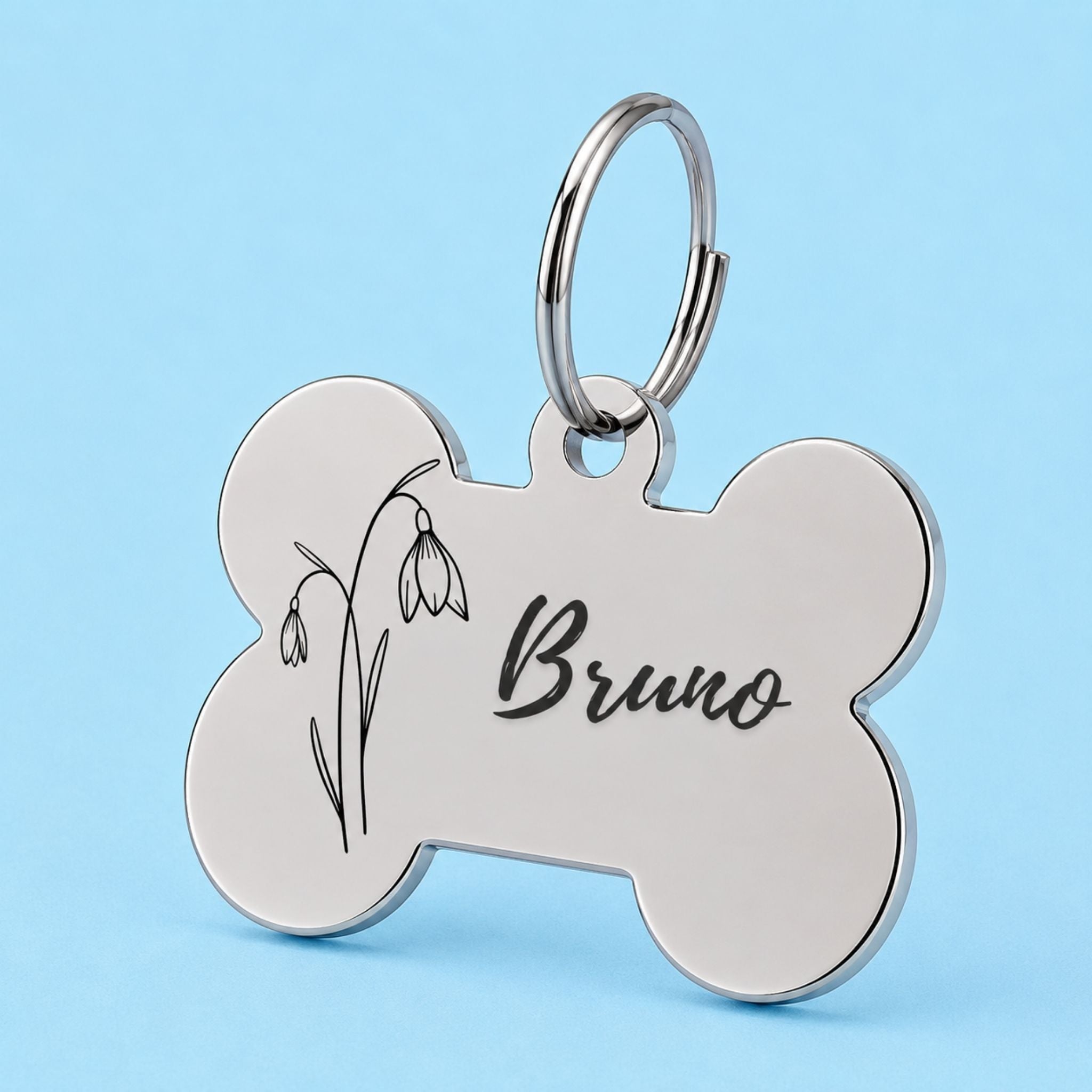
From $22.99
Stainless steel, engraved to order, and designed and made in Maryland. Choose a birth flower design, add your dog's name and your contact information, and get a personalized pet ID tag that is thoughtfully made and built to last.
Shop Birth Flower TagsPersonalizing a Birth Flower Dog Tag
A birth flower dog tag works well as a birthday gift for a dog born in January, a thoughtful add-on for a pet parent whose own birthday falls in January, or a small way to mark a new pet joining the family this time of year. A few ways pet parents personalize theirs:
- Match the birth month: pick the carnation or snowdrop design for a January birthday, or browse the full personalized dog tag collection if another month fits better.
- Add the essentials: your dog's name, your phone number, and any note that helps a stranger get your dog home quickly if they ever slip out of the yard.
- Choose a finish that matches their collar: gold, rose gold, or silver, so the tag looks like part of the outfit rather than an afterthought.
- Pair it with a QR code tag if you want an extra layer of pet safety alongside the engraved information; browse QR code dog tags for that option.
What is the January birth flower?
January has two official birth flowers, the carnation and the snowdrop. The carnation represents love, fascination, and devotion, while the snowdrop represents hope, resilience, and renewal.
Why does January have two birth flowers instead of one?
The birth flower tradition developed across different regions and time periods, and flower availability varied by climate. Carnations were widely available thanks to Mediterranean growing conditions, while snowdrops were a distinctly regional winter bloom, so both became associated with January.
What does a carnation symbolize by color?
Pink carnations represent a mother's love, red represents deep love and admiration, white represents pure love and good luck, and striped or variegated carnations traditionally carry a meaning of regret or decline.
What does a snowdrop flower mean?
The snowdrop symbolizes hope, resilience, and renewal. It is one of the first flowers to bloom at the end of winter, often pushing through frost and snow, which is why it has long been read as a symbol of new beginnings.
Are carnations toxic to dogs?
Yes. The ASPCA lists carnations as toxic to dogs, typically causing mild gastrointestinal upset and mild skin irritation if chewed or eaten. Reactions are usually mild, but it is best to keep fresh arrangements out of reach.
Are snowdrops poisonous to dogs?
Yes. The ASPCA classifies snowdrops as toxic to dogs, with the bulb containing the highest concentration of the plant's natural compounds. Ingestion can cause vomiting, diarrhea, and in some cases a drop in heart rate, so it is worth contacting a veterinarian or the ASPCA Animal Poison Control Center if you suspect your dog has eaten any part of the plant.
What is a good gift for a dog born in January?
A personalized birth flower dog tag is a pet-safe way to mark a January birthday. It carries the same carnation or snowdrop symbolism as fresh flowers, but as an engraved, durable pet ID tag your dog wears every day instead of a bouquet that needs to be kept out of reach.
Quick answer: January's birth flowers are the carnation (love, fascination, devotion) and the snowdrop (hope, resilience, renewal). Both are classified by the ASPCA as toxic to dogs, so a personalized birth flower dog tag is a pet-safe way to carry that meaning without keeping fresh flowers within reach of a curious nose.
Give the January birth flower tradition a home on your dog's collar.
Shop Birth Flower Dog Tags
RELATED POSTS


