


Laser Engraved Dog Tags: How Engraving Methods Compare
Not all "engraved" dog tags are engraved. Here is how embossing, etching, laser marking, annealing, and deep laser engraving really differ, which ones hold up on an active dog, and how to spot the difference before you buy.

In this guide
Picture this: your dog slips out the gate, a kind neighbor kneels down to check the tag, and the phone number has worn into a faint smudge. The tag was there. It just could not do its job.
That is why the engraving method matters as much as the design. Laser engraved dog tags, embossed tags, and the quick etched tags from a store kiosk can look alike on day one, yet wear very differently after a few months of zoomies, swims, and tags clinking together.
This guide breaks down every common pet tag engraving method in plain language, compares them side by side, and gives you a simple test to check any tag before you trust it with your number.
Quick answer: For a dog's everyday ID tag, deep laser engraving on solid stainless steel is the most durable common option, because the laser removes metal to create letters you can feel rather than just changing the surface color. Surface methods such as laser marking, light etching, and marking with a coating can look sharp at first but tend to fade faster as the tag's surface wears. Embossed letters are readable but can flatten or bend.
Why the Engraving Method Matters on a Dog Tag
A pet ID tag lives a rough life. It rubs against the collar, the D-ring, other tags, food bowls, pavement, and sometimes teeth. Every one of those contacts polishes away a tiny bit of the surface.
That is the key idea: anything that lives only on the surface will eventually wear with the surface. Methods that cut into the metal leave the lettering below the surface, so it stays readable much longer.
Readable ID really does help families reunite. In the ASPCA's national lost pet survey, 15 percent of lost dogs were recovered because they wore an ID tag or had a microchip. A tag only counts if a stranger can read it.
6 Pet Tag Engraving Methods, Explained
Laser professionals describe these methods on one spectrum: how much material the process actually moves. Marking changes the surface color, etching melts a shallow layer, and engraving removes material so you can feel it. Here is how each one shows up on pet tags.
1. Embossing (Stamping)
Embossing presses letters into the metal so they stand up as raised characters on the other side, a look familiar from classic military dog tags. There is no added color, so contrast comes only from shadow.
- Pros: classic look, very readable when new, no coloring to fade.
- Cons: raised letters take the brunt of every scrape, so they can flatten, and a bent tag can become hard to read.
2. Quick Laser Etching (Kiosk Tags)
Many same-day tag machines in stores use a small laser to etch information onto the tag in minutes. The result is bright and high contrast at first.
- Pros: fast and convenient, great in a pinch.
- Cons: the mark sits very close to the surface, so it can dull and fade quickly on an active dog.
3. Laser Marking and Annealing
Laser annealing gently heats stainless steel with low power to grow a dark oxide layer. No metal is removed; the surface simply changes color, producing a crisp black mark that feels smooth to the touch.
- Pros: beautiful contrast, smooth finish, widely used on medical and industrial steel parts.
- Cons: because the mark is flush with the surface, heavy abrasion over time can wear it more than a deep cut.
4. Coated Laser Marking (CO2 Laser)
Standard CO2 lasers usually need a marking agent, such as a spray-on coating, to leave a mark on bare metal. The laser bonds that coating to the tag rather than cutting into the steel.
- Pros: dark, readable marks with common equipment.
- Cons: the mark is a bonded layer on top of the metal, so it is typically less durable than engraving on a dog that plays hard.
5. Rotary (Mechanical) Engraving
A spinning cutting tool carves the letters. It was once the standard for metal tags and trophy plates, and depth depends on the machine and the operator.
- Pros: a traditional carved look; depth is possible.
- Cons: slower, less suited to detailed designs, and light jewelry-style cuts may be too shallow for daily wear.
6. Deep Laser Engraving
Deep laser engraving uses a focused beam to vaporize metal and create real grooves. Deeper grooves reflect less light, so the letters look darker, and they sit below the surface where daily rubbing reaches them last.
- Pros: letters you can feel, crisp detail for designs and QR codes, made to stay legible for years.
- Cons: usually ordered online rather than made while you wait.
Laser Engraved Dog Tags vs. Other Methods: Compared
Here is how the common methods stack up for an everyday dog ID tag.
| Method | Removes metal? | Can you feel it? | Typical wear on active dogs | Best for |
|---|---|---|---|---|
| Embossing | No, reshapes it | Yes, raised | Letters can flatten or bend | Classic military style |
| Quick etching | Barely | Rarely | Can fade fast | Same-day backup tag |
| Laser annealing | No, changes color | No, smooth | Moderate; flush with surface | Crisp black marks on steel |
| Coated CO2 marking | No, bonds a coating | No | Can wear with the coating | Budget or decorative items |
| Rotary engraving | Yes, carved | Often | Depends on cut depth | Traditional plates, jewelry |
| Deep laser engraving | Yes, vaporized | Yes | Made to stay legible for years | Everyday pet ID |
The Material Matters Too: Stainless Steel, Aluminum, and Brass
Even the deepest engraving needs good metal underneath. Here is what pet parents should know about common tag materials.
Stainless Steel
Solid stainless steel is a favorite for engraved ID because it is strong, holds deep engraving well, and resists rust in rain, mud, and swims. It is the material we use for our engraved, breed, birth flower, and QR code tags.
Aluminum
Aluminum is lightweight and takes full-color printing beautifully, which is why it is used for photo tags. Because it is a softer metal, it is best matched with printing methods designed for it, and it suits pet parents who want a photo or bold color on the front.
Brass
Brass has a warm vintage look and a long history on collars. It is a softer metal and naturally develops a patina over time, which some pet parents love and others would rather avoid.
How to Tell if a Tag Is Deep Engraved: The 3-Check Test
You do not need a lab to judge a tag. Use these three quick checks on any tag you own or are about to buy.
- The fingernail check. Run a fingernail across the letters. If you feel distinct grooves, the tag is engraved. If it feels perfectly smooth, it is a surface mark, printing, or annealing.
- The angle check. Tilt the tag under a light. Deep engraving keeps its shape and shadow from every angle, while surface marks can seem to disappear in glare.
- The listing check. Look for the words "deep laser engraved" plus a named material, such as "solid stainless steel." Vague phrases like "personalized" or "custom printed" usually signal a surface method.
5 Questions to Ask Before You Buy an Engraved Pet Tag
Whether you shop with us or anywhere else, these questions will tell you a lot about how a tag will hold up.
- What engraving method do you use? A clear answer beats a vague one.
- What is the tag made of? Solid metal is sturdier than plated or coated blanks.
- How many characters fit on the back? You want room for a phone number, a backup contact, and a short note.
- Can I add a QR code? A scannable back lets you update details online without replacing the tag.
- What is the return policy for personalized items? Good sellers stand behind custom products too.
How to Care for an Engraved Dog Tag (and When to Replace It)
A little care keeps any tag readable longer. These habits take seconds:
- Wipe it clean with a soft cloth and mild soapy water after muddy or salty adventures, then dry it.
- Skip harsh abrasives like scouring pads or metal polish, which wear the surface you are trying to protect.
- Reduce the clink. Fewer tags on one ring means less rubbing. A tag silencer can help if your dog wears several.
- Check the split ring monthly for gaps or bending, since a lost tag cannot help anyone.
Replace a tag right away if the phone number is hard to read at arm's length, the tag is bent or cracked, or your contact details have changed. Moving or switching numbers is the most common reason a perfectly durable tag stops being useful.
Example: What 80 Characters Can Hold
Our engraved tags fit up to 80 characters on the back. One simple layout:
- Call Mom 410-555-0123
- Alt 410-555-0456
- Needs daily meds
- I'm microchipped
That is under 70 characters and easy to read at a glance. (The numbers above are placeholders.)
How We Make Our Laser Engraved Dog Tags
Our engraved dog tags start with solid stainless steel and deep laser engraving, not printing or stickers. Each tag is personalized and shipped from Maryland, typically within 2 business days.
- Four shapes: Circle (30 mm), Bone (38 x 25 mm), Diamond (37 mm), and Hexagon (33 mm).
- Four finishes: Silver, Gold, Rose Gold, and Black.
- Ten designs: including Blessed, Florida Sunshine, Lavender, Tahoe, and Wildflower.
- Your choice on the back: up to 80 engraved characters, or a laser-etched QR code that opens your pet's contact profile.
- Ready to wear: a 20 mm stainless steel split ring is included.
Every personalized tag is covered by our 30-day return window, because we want you to feel confident about something your pet will wear every day.
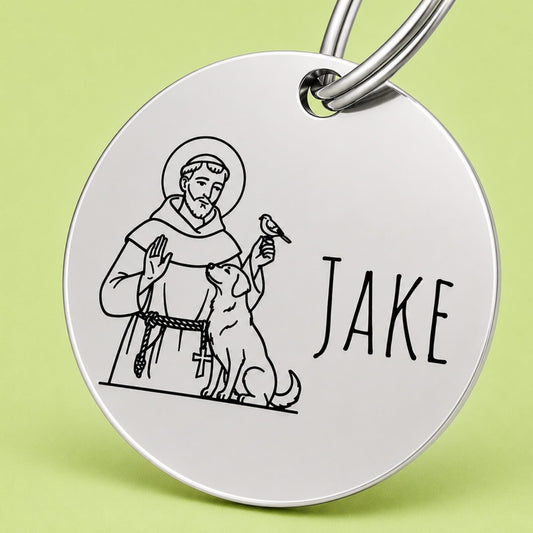
Engraved Dog Tags
From $22.99
Solid stainless steel with deep laser engraving. Four shapes, four finishes, and up to 80 characters or a QR code on the back.
Shop Engraved Tags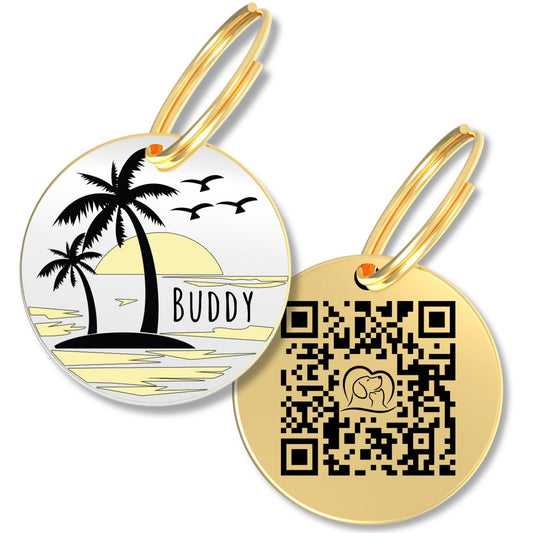
QR Code Dog Tags
From $22.99
A 30 mm stainless steel circle with shiny 3-tone laser engraving on the front and a laser-etched QR code on the back that any phone camera can scan.
Shop QR TagsWant the same deep engraving with more personality? Try breed dog tags with a peek-a-boo portrait of your dog's breed, or birth flower dog tags for a birthday or gotcha day. Prefer your pet's face on the front? Our photo dog tags use full-color printing on lightweight aluminum.
Frequently Asked Questions About Engraved Dog Tags
What is the most durable way to engrave a dog tag?
Deep laser engraving on solid stainless steel is among the most durable common options, because the laser removes metal to form grooves that sit below the surface, where everyday rubbing reaches last.
What is the difference between laser engraving and laser etching?
Both use a laser, but engraving removes enough material to create grooves you can feel, while light etching affects only a shallow surface layer. Shallow marks tend to fade sooner on active dogs.
Is laser annealing the same as engraving?
No. Annealing heats stainless steel to create a dark oxide layer without removing metal, so the mark is smooth and flush. Engraving removes metal to create depth.
Why do engraved dog tags fade?
Tags fade when the marking lives only on the surface, such as light etching, coatings, or some printed finishes. Daily contact with collars, rings, and other tags gradually polishes that surface away.
How long do laser engraved dog tags last?
It depends on the material, depth, and your dog's lifestyle. Deep engraving on stainless steel is made to stay legible for years. Check your tag every few months and replace it if the number is hard to read or your details change.
Are embossed or engraved dog tags better?
Embossed tags are readable and classic, but raised letters can flatten or bend. Deep engraved tags keep lettering below the surface, which usually holds up better on an everyday pet ID.
Is stainless steel or aluminum better for an engraved tag?
Stainless steel is stronger and holds deep engraving well. Aluminum is lighter and ideal for full-color photo printing. Many pet parents choose steel for engraved text and aluminum when they want a photo.
What should I engrave on my dog's tag?
Put your cell phone number first, then your pet's name, a backup contact, any key medical need, and a note like "I'm microchipped." Keep it short so it stays easy to read.
How do I clean an engraved dog tag?
Wipe it with a soft cloth and mild soapy water, rinse, and dry. Avoid scouring pads and harsh polishes, which wear the surface.
The bottom line: The engraving method decides how long your contact details stay readable. Surface methods like light etching, coatings, and annealing sit on the tag's face; embossing raises letters that can flatten; deep laser engraving cuts into the metal. For an everyday ID tag, choose deep laser engraving on solid stainless steel, run the fingernail check, and replace the tag whenever your details change.
Sources and Further Reading
- Laserax: Laser Engraving, Etching, and Annealing Explained
- CMS Laser: The Difference Between Laser Marking and Engraving Metal
- Graphics Pro: Laser Engraving vs. Laser Marking
- ASPCA: How Many Pets Are Lost? How Many Find Their Way Home?
A tag is only as good as the words people can read on it.
Choose deep laser engraving, made just for your pet.
RELATED POSTS


