

Pet ID Tags: Why Every Dog Needs One (Even If Chipped)
A microchip is a great backup, but a finder standing on the sidewalk with your dog can't read it. Here's why pet ID tags still matter for every dog, what to engrave, and how to build an ID setup that actually helps bring them home.
Picture this: the landscaper leaves the side gate open for three minutes. Your dog, who has never once wandered off, spots a squirrel and is gone. Ten minutes later, a neighbor two streets over is kneeling beside them, looking at the collar.
What happens next depends almost entirely on what that neighbor finds hanging from the D-ring. If there's a tag with your phone number, you'll probably get a call before you've finished checking the backyard. If there's nothing, your dog's next stop may be a shelter across town.
That's the whole case for pet ID tags in one scene. Below, we'll walk through why every dog needs one (yes, even microchipped, indoor, and "perfectly trained" dogs), what the research actually shows, and exactly what to engrave.
Quick answer: Every dog needs an ID tag because it is the only form of identification anyone can read instantly, without a scanner, an app, or a trip to a vet. A microchip is a permanent backup, but it only works after someone brings your dog to a shelter or clinic and the registry details are current. Pair a visible tag with your phone number and a registered microchip for the strongest protection.
What Is a Pet ID Tag?
A pet ID tag is a small metal or printed tag that hangs from your dog's collar and shows the contact details a finder needs to reach you. Most dog ID tags carry a phone number and your pet's name, and many add a backup number, a medical note, or a QR code that opens a contact profile.
It's worth knowing that a pet ID tag is different from the other tags your dog may wear:
- ID tag: your personal contact tag. You choose what goes on it.
- Rabies tag: issued by your vet after vaccination, with a number tied to the vaccine record.
- License tag: issued by your city or county where dog licensing is required.
- Microchip registry tag: sometimes supplied by chip companies, showing the registry's number rather than yours.
Rabies and license tags help officials, but they send a finder to an office, not to you. Your personal ID tag is the one that closes the gap fastest.
Why Every Dog Needs an ID Tag: 9 Reasons
1. It's the fastest route home
A tag turns a stranger into a helper in seconds. The ASPCA's Dr. Emily Weiss put it simply: if a lost pet had worn a tag, "he could've been home by dinner."
Many lost dogs are found close to home, often by a neighbor. A readable phone number means that neighbor can call you directly instead of driving to a shelter.
2. Anyone can read it, no equipment needed
A microchip needs a scanner, and scanners live at shelters, vet clinics, and animal control. As the American Kennel Club notes, a tag can be read without special equipment. The finder just needs eyes and a phone.
3. It tells the world your dog is loved, not a stray
A dog with a collar and tag reads as someone's family member. Finders are more likely to approach, hold onto, and call about a dog that is clearly owned, rather than assuming it was abandoned.
4. Microchips have real-world gaps
Microchips are excellent, and we recommend them. But in a landmark study of more than 7,700 microchipped shelter animals, only about 58% of chips were actually registered in a database when shelters checked, and wrong or disconnected phone numbers were the top reason owners couldn't be reached (JAVMA, 2009). A tag gives the finder a second, faster path.
5. "Indoor" and "well-trained" dogs still slip out
Most dogs who go missing weren't planning an adventure. Common triggers include:
- Fireworks, thunderstorms, and other sudden loud noises
- Open doors during deliveries, parties, or home repairs
- Moving day, road trips, and new surroundings
- A new pet sitter, dog walker, or boarding stay
- Slipped leashes, broken fences, or a car accident
The dogs who "never run" are often the ones whose families skip the tag, which is exactly why they need one.
6. It prevents mix-ups at daycare and the dog park
Two black Labs, one busy play group. A name and number on the collar help walkers, groomers, and daycare staff confirm who belongs to whom at a glance.
7. It can carry lifesaving medical info
A short note like "NEEDS MEDS" or "DIABETIC" tells a finder that time matters. That urgency often speeds up the call.
8. Your local rules may require one
Many U.S. cities and counties require dogs to wear a current rabies or license tag in public. Requirements vary, so check with your local animal control. In some countries, like the UK, a dog in public must wear a tag with the owner's details even when microchipped.
9. Peace of mind for you (and everyone who cares for your dog)
A tag is a small, one-time step that quietly protects your dog every single day. It also gives sitters, walkers, and family members an easy backup if something unexpected happens on their watch.
What the Research Says About Dog ID Tags
You'll often see "1 in 3 pets will get lost in their lifetime" repeated online. It's a popular line, but independent lost-pet researchers haven't been able to trace it to a published study. Here's what the peer-reviewed and survey data actually show:
| Finding | What it means for you | Source |
|---|---|---|
| About 14% of dogs went missing at least once over five years | Losing a dog is common enough to plan for | ASPCA survey, 2012 |
| 93% of those lost dogs were recovered | Most dogs come home, and ID helps it happen faster | ASPCA survey, 2012 |
| 14% of recovered dogs were found through an ID tag | Tags work, and they work without a scanner | Weiss et al., 2012 |
| 80% of pet parents said ID tags are very or extremely important, but only 33% always kept one on | The biggest risk isn't the tag, it's not wearing it | ASPCA study, 2011 |
| Shelter dogs with microchips went home 52.2% of the time vs 21.9% without | Chips matter; keep registration current | AVMA / JAVMA |
| Only 58.1% of scanned chips were registered | An unregistered chip can't reach you | Lord et al., JAVMA 2009 |
The takeaway: tags and microchips aren't rivals. Each covers the other's weak spot, and the single biggest improvement most pet parents can make is simply keeping the tag on every day.
Pet ID Tags vs Microchips vs QR Code Tags
Each ID method does a different job. Here's how they compare side by side:
| Feature | Engraved ID tag | QR code tag | Microchip |
|---|---|---|---|
| Who can read it | Anyone, instantly | Anyone with a smartphone camera | Shelters, vets, animal control |
| Equipment needed | None | Phone camera (no app for the finder) | Microchip scanner |
| Where it lives | On the collar | On the collar | Under the skin |
| Can fall off? | Yes, if the collar comes off | Yes, if the collar comes off | No, it's permanent |
| Main weak spot | Limited space; must be updated if you move | Finder has to think to scan it | Useless if unregistered or outdated |
| Shows location? | No | No, it's a scan-to-contact profile, not GPS | No, it isn't a GPS device |
| Best role | Fast first contact | Fast contact plus extra details | Permanent backup |
Bottom line: use a visible tag for speed and a microchip for permanence. If you want both engraved text and a scannable profile, choose a tag with a QR back.
The 3-Layer ID System (Our Simple Framework)
After helping pet families personalize tags every day, we've found the most reliable setup comes down to three layers that back each other up.
Layer 1: A visible tag with your phone number
This is your first responder. It should be legible, current, and on your dog whenever they're awake and out of the crate.
Layer 2: A registered microchip
This is your safety net if the collar comes off. Register the chip, then verify your details once a year. August 15 is the AVMA's Check the Chip Day, an easy annual reminder.
Layer 3: A scannable profile (optional but helpful)
A QR code on the tag lets a finder open your pet's contact profile with a phone camera. It's a helpful extra for dogs with medical needs or families who want more than a few lines of text available.
Try the 5-Second Finder Test
Hand your dog's collar to a friend and ask them to find a way to reach you in five seconds. If they squint, flip the tag twice, or reach a disconnected number, it's time for a new tag.
What to Put on a Dog ID Tag
Space is limited, so every character should earn its place. In order of priority, include:
- Your primary phone number. The one you answer fastest, usually your cell.
- A backup number. A partner, family member, or trusted neighbor.
- Your dog's name (optional). It can help a finder calm your dog, but some pet parents skip it.
- A medical alert. "NEEDS MEDS," "DEAF," or "DIABETIC" if relevant.
- "I'M MICROCHIPPED." This nudges a finder to get your dog scanned.
- City and state, or a short cue. Helpful if your dog travels with you.
What to leave off your dog's tag
- Your full street address. A city or ZIP is usually enough.
- Phone numbers you rarely answer. An old landline or work line can delay the call.
- Too much text. Crowded tags are hard to read, especially on small dogs.
Example tag layouts for real-life situations
PawFurEver engraved tags fit up to 80 characters on the back. Here's how we'd use that space:
| Situation | Suggested back engraving |
|---|---|
| City apartment dog | CALL MY MOM 555-123-4567 · DAD 555-987-6543 · I'M MICROCHIPPED |
| Dog with a medical need | NEEDS DAILY MEDS · CALL 555-123-4567 · ALT 555-987-6543 |
| Adventure or travel dog | DENVER CO · 555-123-4567 · IF I'M FAR FROM HOME, PLEASE CALL |
| Senior dog | I'M DEAF & SLOW · PLEASE CALL 555-123-4567 |
| Newly adopted rescue | NEW HERE, I MAY BE SHY · 555-123-4567 · CHIPPED |
Prefer a scannable profile instead? You can choose a laser-etched QR code on the back of most PawFurEver tags at checkout.
How to Choose the Right Dog ID Tag
Material: stainless steel vs aluminum
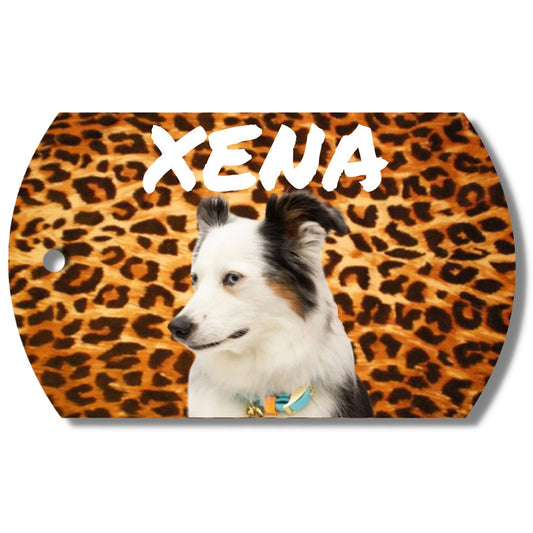
Material decides how long your tag stays readable. Solid stainless steel with deep laser engraving is made to stay legible for years. Lightweight aluminum is ideal for full-color printed designs, like tags featuring your dog's photo.
Legibility: engraved beats stickered
Look for laser engraving rather than printed stickers or shallow marks. Engraving removes metal to create text, so it holds up far better to daily wear, collar rubbing, and wet walks.
Size and weight
A tag should be readable at arm's length without weighing your dog down. Our 30 mm circle is light enough for puppies and small breeds, while the 38 x 25 mm bone gives bigger dogs a little more visible space.
Style and personalization
Here's the fun part. A tag your dog wears every day can reflect who they are. Popular options include:
- Breed dog tags with a peek-a-boo portrait of your dog's breed
- Birth flower dog tags for a birthday or gotcha day
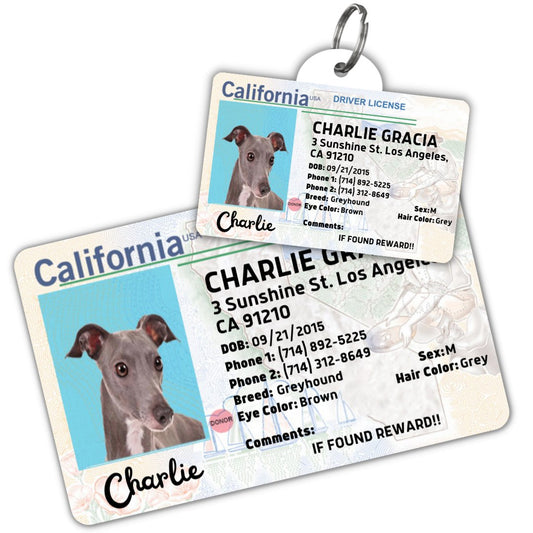
- Driver license dog tags styled after your state's license
- Holiday dog tags for Halloween and Christmas
Attachment and fit
A sturdy stainless steel split ring on the collar's D-ring keeps your tag secure. Pair it with a comfortable, well-fitted collar; you should be able to slide two fingers under it.

Engraved Dog Tags
Solid stainless steel · 4 shapes · 4 finishes
Deep laser engraving made to stay legible for years. Choose up to 80 characters or a laser-etched QR code on the back.
Shop Engraved Tags
QR Code Dog Tags
Stainless steel · 30 mm circle · QR back on every tag
3-tone engraving on the front and a QR code on the back that opens your pet's contact profile with any phone camera.
Shop QR Code Tags
Photo Dog Tags
Lightweight aluminum · full-color print · 2 x 1 in
Your dog's photo on the front, so a finder can match face to tag. Add a QR code or up to 80 characters on the back.
Shop Photo TagsWhen Should Your Dog Wear an ID Tag?
The short answer: whenever they're not crated or bathing. That includes time inside the house, because many escapes start at the front door.
The exceptions
- In the crate: remove the collar so tags can't catch on the bars.
- Rough, unsupervised play: dogs wrestling can snag each other's collars.
- Bath time: put the collar right back on afterward.
New puppies and adopted dogs
Put a collar and tag on before you walk out of the shelter or breeder's door. New places are stressful, and a nervous new dog hasn't learned your voice yet. If your custom tag hasn't arrived, a temporary tag with your number is far better than nothing.
7 Common Dog ID Tag Mistakes to Avoid
- Relying on the microchip alone. A finder can't read it on the sidewalk.
- Forgetting to update after a move or new number. An outdated tag is a dead end.
- Letting engraving wear down. If you can't read it easily, neither can a stranger.
- Taking the collar off "just for today." Escapes rarely happen on schedule.
- Only wearing rabies or license tags. They route finders to an office, not to you.
- Overcrowding the tag. Two clear numbers beat six cramped lines.
- Skipping ID during travel. Unfamiliar places are when dogs are most likely to bolt.
Your quick tag checkup (do it twice a year)
- Is every phone number current and answered?
- Is the engraving easy to read at arm's length?
- Is the split ring closed tightly and free of wear?
- Is the microchip registered with your current details?
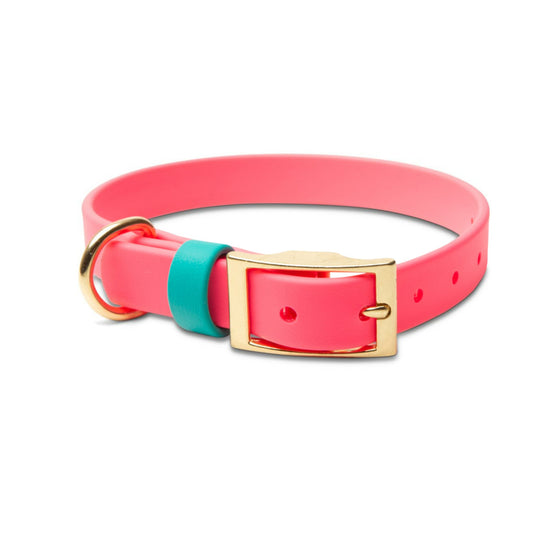
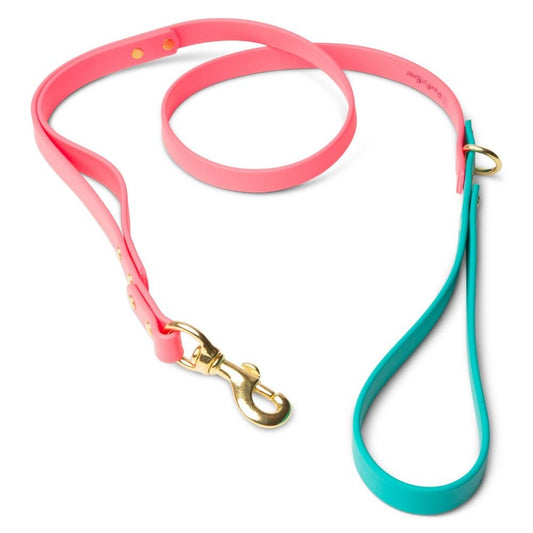
For more on how scannable tags work, see our guide QR Code Dog Tag: How It Works & Why It's Worth It. And if you want everything to match, our waterproof biothane dog collars are made in Maryland and pair with any PawFurEver tag.
Frequently Asked Questions About Pet ID Tags
Does my dog need an ID tag if they're microchipped?
Yes. A microchip can only be read with a scanner at a shelter, vet, or animal control office, and it only helps if the registry details are current. An ID tag lets anyone contact you right away, so the two work best together.
What should you not put on your dog's ID tag?
Skip your full street address, phone numbers you rarely answer, and long messages that make the tag hard to read. A city or ZIP code is usually enough location detail.
What legally needs to be on a pet tag?
In the U.S., there's no single national rule. Many cities and counties require a current rabies or license tag on the collar, so check with your local animal control. Some countries, including the UK, require the owner's name and address on a tag in public.
Should I put my dog's name on the ID tag?
It's a personal choice. A name can help a finder calm and call your dog, while some pet parents leave it off for privacy. Either way, your phone number is the most important line.
Which pet ID tag is best for my dog?
Look for a durable material, deep engraving, and a size your dog carries comfortably. Stainless steel with laser engraving suits most active dogs, while printed aluminum works well for photo designs. A QR back adds a scannable profile.
Where can I get a free pet ID tag?
Some shelters, rescues, and veterinary clinics hand out basic tags at adoption or during events, so it's worth asking locally. For a tag built to last and made just for your pet, a personalized engraved tag is a small, worthwhile investment.
Do QR code dog tags track my dog's location?
No. A QR code tag is a scan-to-contact tool, not a GPS or live tracking device. When a finder scans it with a phone camera, it opens your pet's contact profile so they can reach you.
How often should I replace my dog's ID tag?
Replace it whenever your phone number or address changes, or when the text becomes hard to read. A quick check twice a year catches worn engraving and loose split rings early.
Should my dog wear their tag inside the house?
Yes. Many dogs get lost by slipping out an open door, so wearing ID at home matters. The main exception is the crate, where tags could catch on the bars.
Do cats need ID tags too?
They do. Cats in the ASPCA survey were less likely than dogs to be recovered. Use a breakaway collar and a lightweight tag sized for a cat.
Key takeaways: Every dog needs a visible ID tag because it's the fastest way a finder can reach you. Engrave your cell number and a backup, add a medical note if needed, and keep your dog's microchip registered as a permanent backup. Check the tag twice a year, and keep it on your dog every day.
Sources
- ASPCA: How Many Pets Are Lost? How Many Find Their Way Home? (2012)
- ASPCA: Do Your Pets Wear an ID Tag? They Should. (2011)
- Lord et al., Characterization of animals with microchips entering animal shelters, JAVMA (2009)
- AVMA: Check the Chip
- American Kennel Club: Are ID Tags Enough?
- Lost Pet Research and Recovery: Lost Pet Statistics
Give Your Dog a Tag Made Just for Them
Personalized pet ID tags with deep laser engraving or a scannable QR code, personalized and shipped from Maryland in 2 business days. Every order is covered by our 30-day return window.
Personalize Your Tag